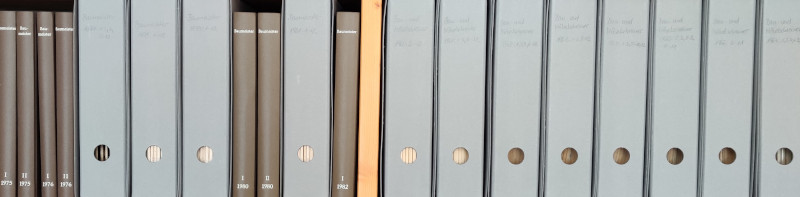


The saai as worksite
The saai | Archive for Architecture and Civil Engineering is one of the most important architecture collections in Germany. In addition to preserving extensive records (including Frei Otto, Egon Eiermann, Günter Behnisch, Günter Wilhelm, Myra Wahrhaftig, Friedrich Weinbrenner, Heinrich Hübsch), research content is made accessible and published as part of exhibition and publication projects. With the newly launched research center iaas | Center for International Architectural Archival Studies, research is now located within the saai itself. As archive for architectural and engineering works with estates of regional architects of international importance, the saai is at the same time material, toolkit and field of experimentation. The iaas makes use of this unique position in the saai archive utilizing the synergies of the interdisciplinary team and the links between analog and digital processes, from two-dimensional files to three-dimensional models, the time lapses of long-term storage to the speed of AI-controlled data acquisition, and from material restoration processes to digital erosion. The location of the saai at the KIT, a University of Excellence and Helmholtz research center, allows manifold links to the philosophy of science, computer science, engineering and, last but not least, architecture and art history; proximity to Karlsruhe’s other international institutions such as the ZKM (Center for Art and Media Karlsruhe) and its central location within Europe foster further connections
The Residency is a cooperation with the Wüstenrot Foundation. The Wüstenrot Foundation is committed to preserving, researching, and sharing cultural heritage, with a focus on material and immaterial assets. By supporting museums and collections, it helps uncover and make accessible hidden treasures from archives, including under-researched works and estates, particularly from the 20th century. This ensures their preservation and integration into public and academic memory through restoration, research, exhibitions, and publications.
Residents will be expected to work on site in the saai, to present their work in progress in a workshop with students and researchers, and to write a short report on their stay accompanied by visual material (i.e. from their work with the archive). The new saai podcast “Archive Gossip” will feature the residents’ research in one episode produced during their stay.
2026 Theme: What Schools Should We Build? Tracing Architecture Teaching in the Archive
This year the call addresses scholars with projects or case studies that investigate the question of concepts of "schools" or architectural education as processes, tools, materials and networks that lay the foundations for architectural knowledge. The history and holdings of the saai archive as well as the legacy of the KIT (formerly Polytechnische Schule, Technische Hochschule) is often defined by influential teachers such as Friedrich Weinbrenner or Egon Eiermann. But how do such "schools" get defined? How can one analyze them historically through the layers of self-historization, hearsay and erasures? How does the dominance of the teacher figures complicate histories of both students and colleagues with different approaches?
Beyond the question of the school at its configuration and canonization, we are interested in the methodological questions of architectural teaching: How does a (seemingly) shared architectural language get solidified, homogenized or built? Which tools are used to build common references or skills?
This year, we want to investigate processes of pedagogical experimentation, disciplinary canonization, the interrogation of "legacy" and "schools"; both what architecture teaching is as well as who performed it and how is at the focus of the investigations. Through saai holdings for example of several students of Friedrich Weinbrenner or Egon Eiermann, but also through materials such as sketchbooks, book or slide collections, or, alternatively, by tracing missing protagonists, alternative schools and approaches through oral histories, we hope to complicate and illuminate what has been told—and what has not yet—as the histories of architecture schools and their tools.
What we offer
- A residency that will take place between June 22 and July 31 in Karlsruhe
- The saai archive with its (partially still unprocessed) archival materials
- A workplace in the saai
- Length of Stay between 4 to 6 weeks (please indicate your preferred duration in the cover letter, the start date is mandatory)
- Accommodation in the Gastdozentenhaus of the KIT
- Travel costs to and from Karlsruhe
- Modest compensation for increased cost of living
What you submit
- Letter of motivation explaining how a stay at saai would benefit your research project and your preferred dates for your time in Karlsruhe (max. 1 page)
- Project Abstract that demonstrates the connection to the 2026 theme (max. 500 words)
- CV (max. 3 pages)
Important Dates
Call: 20 February 2026
Deadline for Application: 20 March 2026
Notification of Acceptance: 3 April 2026
Acceptance/Declining of Offer: 24 April 2026
Residency: 22 June – 31 July 2026 (4-6 weeks)
Public Workshop: 16 or 17 July 2026
Contact
Information about the program
Prof. Dr. Anna-Maria Meister
anna-maria meister ∂does-not-exist.kit edu
Dr. Doris Hallama
doris hallama ∂does-not-exist.kit edu
Send Submissions to
Kevin Schleifer
kevin schleifer ∂does-not-exist.kit edu