
Metadata Ecologies—Translational Struggles in "Intelligent" Archives
About the Event
In our workshop Metadata Ecologies—Translational Struggles in “Intelligent” Archives from 2–4 March 2026 at the saai | Archive for Architecture and Engineering, we will kick-off a research initiative investigating how metadata—whether painstakingly crafted over time (“slow”) or generated and adapted by algorithms (“fast”)—shapes the architectures of knowledge in archives past, present, and future.
The initiative positions metadata as a dynamic and contested site of experimentation—a medium in its own right, shaping how archives are made, accessed, and reimagined. By developing vocabularies, methods, and prototype systems, the project aims to inaugurate a sustained research agenda around “intelligent” archives: responsive, critical, and inclusive metadata architectures attuned to translational struggle and ecological complexity.
For the workshop, we want to probe the processes in and around archives not from abstract meta-positions, but from within; at stake is not only the circulation (and hence re-enforcement of bias and epistemologies) of metadata across systems, but also the practices of translation that sustain or unsettle them. Besides scholarly exchange we will also test strategies and approaches on and around objects with an object hackathon, each participant engaging their respective approach and expertise to extract, project, describe or define metadata of shared archival objects.
Image Caption
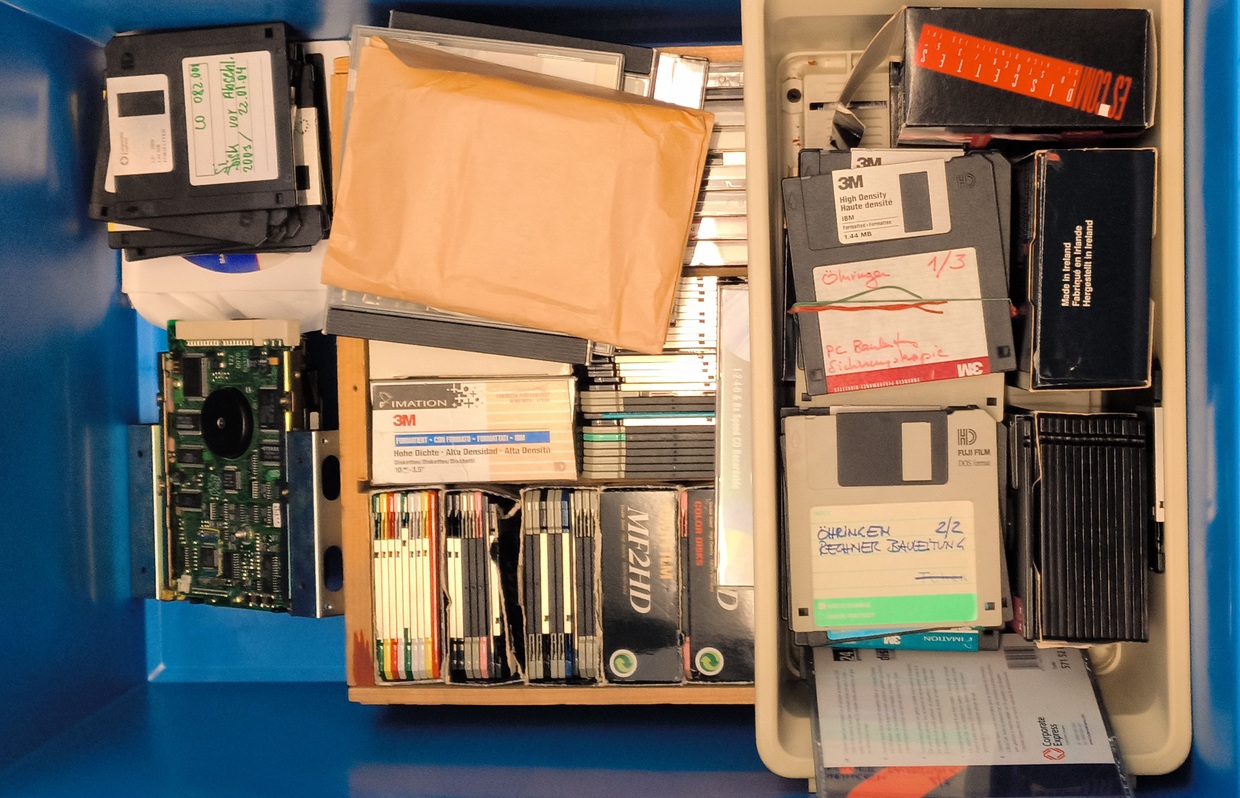
Floppy disks CDs, and an IDE hard drive from the Behnisch Werkarchiv, saai Archive for Architecture and Engineering, KIT Karlsruhe. Photo: Joshua Silver.
Organizers
Joshua Silver (saai, Karlsruher Institut für Technologie)
Mechthild Ebert (saai, Karlsruher Institut für Technologie)
Anna-Maria Meister (saai, Karlsruher Institut für Technologie, Kunsthistorisches Institut in Florenz - Max-Planck-Institut)
Sina Brückner-Amin (formerly saai, Karlsruher Institut für Technologie)
with the saai
Funded by
KIT Future Fields in cooperation with the Lise Meitner Group “Coded Objects” at the Kunsthistorisches Institut in Florenz – Max Planck Institute
List of speakers
Damjan Kokalevski (Architekturmuseum, TU München)
Wim Lowet (Vlaams Architectuurinstituut)
Felix Mittelberger (ZKM)
Iris Ranzinger (Architekturzentrum Wien)
Tomás Rodríguez Rivero (Universidad Politécnica de Madrid)
Rafael Uriarte (Kunsthistorisches Institut, Florenz)
Melissa Vincent (London School of Economics)
Maddy Young (University of Manchester)
Jonas Zilius (Karlsruher Institut für Technologie)
Participation
Participation is free of charge. No registration is required.
Program
March 2, 2026 – Day 1: the shape of the box
What is the shape of the Blackbox of our practices? What “tacit knowledge” of the digital have we developed to deal with the material we compile, link, and render performative? Day 1 of the workshop will consist of informal sessions where we invite participants to present on aspects of their research and practice related to the workshop themes. Speakers are organized into three key archival practices: 1) Compiling (storing, collecting, acquiring, curating, preserving), 2) Linking (databasing, searching, sharing, tagging, making-accessible), 3) Bit-Rotting (decay, disposal, enclosure, deletion, erasure).
Faculty of Architecture
Seminar Room 104 “Grüne Grotte” (1st floor)
Building 20.40
Englerstraße 7
76131 Karlsruhe
| 9:00 Coffee and Breakfast Snacks |
| 9:30 Introduction |
|
10:00 - 12:30 sharing session 1: Compiling, Chairing: Virgina Marano |
| 12:30 - 13:30 lunch |
| 13:30 - 16:00 sharing session 2: Linking, Chairing: Maryia Rusak 13:30 - 15:00 Jonas Zilius — Nuclear Research Institute (either not-yet tagged images or image recognition) Iris Ranzinger — AzW Database project with focus on linking with open data/online frontend Tomàs Rodriguez — “Prototyping a dynamic catalogue interface for Lacaton Vassal´s living architectural archive in the making” Daniel Weiss — 15:00 - 15:15 Coffee Break 15:15 - 16:00 Panel Discussion |
| 16:00 - 16:30 Coffee Break |
|
16:30 - 19:00 sharing session 3: (Bit-)Rotting, Chairing: Anna-Maria Meister |
| 19:30 - workshop dinner |
March 3, 2026 – Day 2: Opening the Blackbox
Archival material, whether a novel digital storage medium or conventional paper drawings do not exist without the supporting practices and technologies for rendering them as stable entities while guaranteeing their status as evidence. They are not, we contend, simply objects. They are whole systems or networks. A series of three sessions will scaffold us toward a new, shared ontology of architectural artefacts. First, we will subject an existing archival ontology to a test, transforming it in the process. Then, we will work through the result of that test to describe or de-script our objects. Finally, these descriptions will provide an input for our summative collective diagram of a relational ontology for architectural artefacts.
saai | Archive for Architecture and Engineering
Kaiserstraße 8
76131 Karlsruhe
| 09:30 Coffee and Breakfast Snacks |
| 10:00 Introduction |
| 10:30 - 12:30 Morning Workshop Session | uncrackable artefacts To ease everyone into the day, this session will focus more on “storytelling” through a series of demos. Participants are invited to share their “uncrackable artefact” to the group by way of a short demo. Some ideas: 1. Did you finally crack your “uncrackable artefact?” Show us what you did! 2. Did the process of trying to crack your artefact render something else interesting about it? What was it, and how did you find out! 3. Did you access your artefact in a different way that its original mode of accessing? What did you find? 4. Did translating your artefact (eg. digitizing) render something new and interesting despite your not being able to “crack” its code? What did you find and how! |
| 12:30 - 14:00 lunch at Kulturküche |
| 14:00 - 16:00 Afternoon Workshop Session | de-scripting inscrutable metadata Current archival organizational models are unsatisfactory for the wider array of artefacts which constitute research data for architectural historians, social scientists and theorists. The “uncrackable artefacts” of the archive and beyond do not rectify well to these received ways of thinking, describing, and categorizing entities. Participants, then, will be tasked with subjecting an existing archival metadata scheme (the “Art and Architecture Thesaurus” [AAT]) to a trial of strength. Participants will swap artefacts, then try to fit this artefact into the existing scheme. Participants are encouraged to rework the AAT scheme on the fly, adding new categories or reworking categories to include descriptive elements they deem interesting and necessary. In short, we will be pushing an existing system past its limit, to the point of failure. Each participant’s reworked metadata scheme will be used as an input for the following activity. Through the modified metadata scheme, and your own research methods/interests, describe or “descript” (Akritch) the artefact you brought. You will be tasked with writing this description on a single sided index card. Participants are encouraged to take description in its widest possible definition. One, for example, could write a Haiku, C++ Object class, first-person narrative, technical description, etc. Participants will then reflect through the following questions: 1. Where did the most friction take place between your artefact/object and the existing AAT scheme? 2. What kinds of information became more important for grasping the full scope and importance of your artefact/object? 3. What elements of your object/artefact remain resistant to organization? |
|
16:00 - 18:00 Sum Up Session | towards a relational ontology of architectural artefacts |
March 4 2026 – Day 3: Archive tour
For those who are interested, there will be an Archive tour at ZKM and saai.
saai | Archive for Architecture and Engineering
Kaiserstraße 8
76131 Karlsruhe