
Metadata Ecologies—Translational Struggles in "Intelligent" Archives
Zur Veranstaltung
In unserem Workshop Metadata Ecologies—Translational Struggles in "Intelligent" Archives, der vom 2. bis 4. März 2026 am saai | Archiv für Architektur und Ingenieurbau stattfindet, starten wir eine Forschungsinitiative, die untersucht, wie Metadaten—ob über lange Zeiträume sorgfältig erarbeitet („slow“) oder algorithmisch erzeugt und angepasst („fast“) —die Wissensarchitekturen von Archiven in Vergangenheit, Gegenwart und Zukunft prägen.
Die Initiative versteht Metadaten als einen dynamischen und umkämpften Ort des Experimentierens—als ein eigenständiges Medium, das beeinflusst, wie Archive entstehen, zugänglich gemacht und neu gedacht werden. Durch die Entwicklung von Vokabularen, Methoden und prototypischen Systemen zielt das Projekt darauf ab, eine langfristige Forschungsagenda zu „intelligenten“ Archiven zu begründen: reaktive, kritische und inklusive Metadatenarchitekturen, die auf Übersetzungsprozesse und ökologische Komplexität abgestimmt sind.
Im Workshop möchten wir Prozesse in und um Archive nicht aus abstrakten Metaperspektiven betrachten, sondern aus ihrer inneren Praxis heraus. Im Fokus steht dabei nicht nur die Zirkulation von Metadaten zwischen Systemen—und damit die mögliche Verstärkung von Bias und epistemologischen Strukturen—sondern auch die Übersetzungspraktiken, die diese stabilisieren oder infrage stellen. Neben dem wissenschaftlichen Austausch werden wir Strategien und Ansätze in einem objektbezogenen Hackathon erproben. Dabei bringen die Teilnehmenden ihre jeweiligen Perspektiven und Expertisen ein, um Metadaten gemeinsamer Archivobjekte zu extrahieren, zu projizieren, zu beschreiben oder zu definieren.
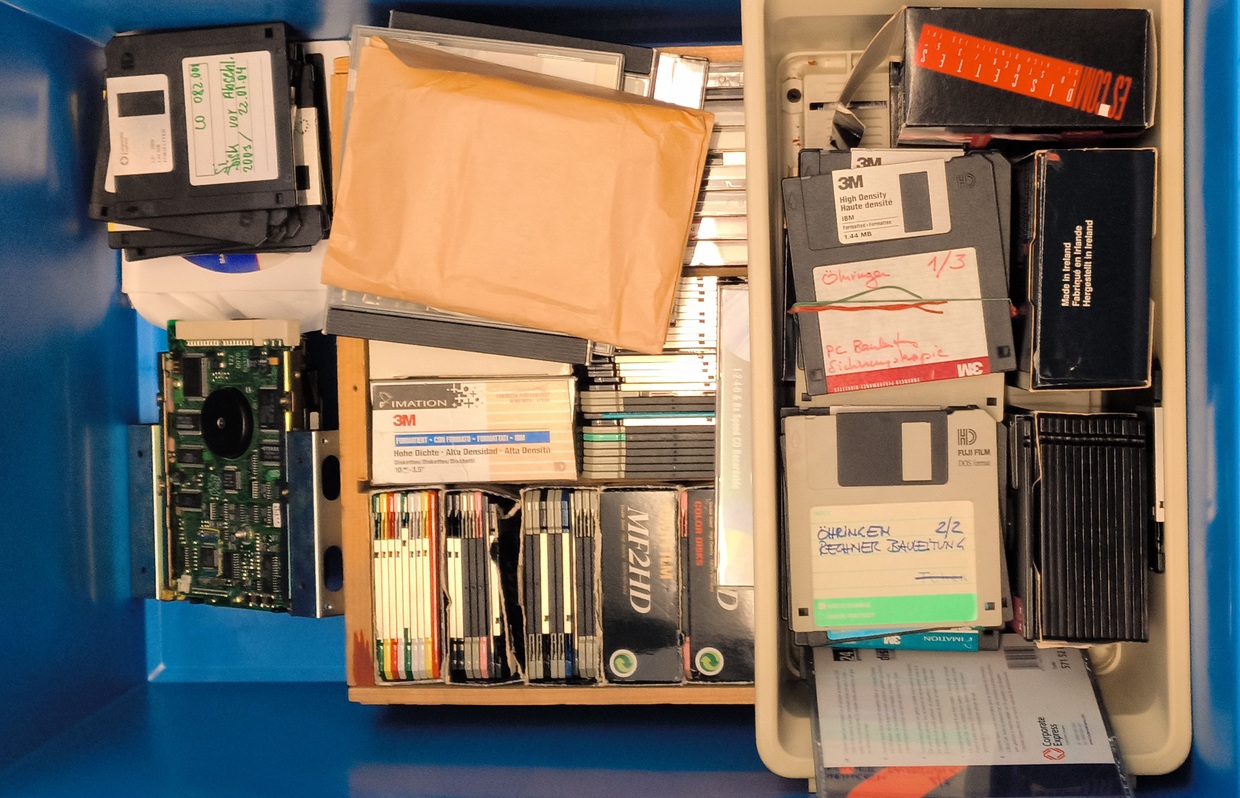
Bildunterschrift
Disketten, CDs und eine IDE-Festplatte aus dem Behnisch Werkarchiv, saai Archiv für Architektur und Ingenieurbau, KIT Karlsruhe. Foto: Joshua Silver.
Organisation
Joshua Silver (saai, Karlsruher Institut für Technologie)
Mechthild Ebert (saai, Karlsruher Institut für Technologie)
Anna-Maria Meister (saai, Karlsruher Institut für Technologie, Kunsthistorisches Institut in Florenz - Max-Planck-Institut)
Sina Brückner-Amin (ehemals saai, Karlsruher Institut für Technologie)
gemeinsam mit dem saai
Gefördert durch
KIT Future Fields in Kooperation mit der Lise Meitner Gruppe „Coded Objects“ am Kunsthistorischen Institut in Florenz – Max Planck Institut
Referierende
Damjan Kokalevski (Architekturmuseum, TU München)
Wim Lowet (Vlaams Architectuurinstituut)
Felix Mittelberger (ZKM)
Iris Ranzinger (Architekturzentrum Wien)
Tomás Rodríguez Rivero (Universidad Politécnica de Madrid)
Rafael Uriarte (Kunsthistorisches Institut, Florenz)
Melissa Vincent (London School of Economics)
Maddy Young (University of Manchester)
Jonas Zilius (Karlsruher Institut für Technologie)
Teilnahme
Die Teilnahme ist kostenlos. Eine Anmeldung ist nicht erforderlich.
Programme
March 2, 2026 – Day 1: the shape of the box
What is the shape of the Blackbox of our practices? What “tacit knowledge” of the digital have we developed to deal with the material we compile, link, and render performative? Day 1 of the workshop will consist of informal sessions where we invite participants to present on aspects of their research and practice related to the workshop themes. Speakers are organized into three key archival practices: 1) Compiling (storing, collecting, acquiring, curating, preserving), 2) Linking (databasing, searching, sharing, tagging, making-accessible), 3) Bit-Rotting (decay, disposal, enclosure, deletion, erasure).
Faculty of Architecture
Seminar Room 104 “Grüne Grotte” (1st floor)
Building 20.40
Englerstraße 7
76131 Karlsruhe
| 9:00 Coffee and Breakfast Snacks |
| 9:30 Introduction |
|
10:00 - 12:30 sharing session 1: Compiling, Chairing: Virgina Marano |
| 12:30 - 13:30 lunch |
| 13:30 - 16:00 sharing session 2: Linking, Chairing: Maryia Rusak 13:30 - 15:00 Jonas Zilius — Nuclear Research Institute (either not-yet tagged images or image recognition) Iris Ranzinger — AzW Database project with focus on linking with open data/online frontend Tomàs Rodriguez — “Prototyping a dynamic catalogue interface for Lacaton Vassal´s living architectural archive in the making” Daniel Weiss — 15:00 - 15:15 Coffee Break 15:15 - 16:00 Panel Discussion |
| 16:00 - 16:30 Coffee Break |
|
16:30 - 19:00 sharing session 3: (Bit-)Rotting, Chairing: Anna-Maria Meister |
| 19:30 - workshop dinner |
March 3, 2026 – Day 2: Opening the Blackbox
Archival material, whether a novel digital storage medium or conventional paper drawings do not exist without the supporting practices and technologies for rendering them as stable entities while guaranteeing their status as evidence. They are not, we contend, simply objects. They are whole systems or networks. A series of three sessions will scaffold us toward a new, shared ontology of architectural artefacts. First, we will subject an existing archival ontology to a test, transforming it in the process. Then, we will work through the result of that test to describe or de-script our objects. Finally, these descriptions will provide an input for our summative collective diagram of a relational ontology for architectural artefacts.
saai | Archive for Architecture and Engineering
Kaiserstraße 8
76131 Karlsruhe
| 09:30 Coffee and Breakfast Snacks |
| 10:00 Introduction |
| 10:30 - 12:30 Morning Workshop Session | uncrackable artefacts To ease everyone into the day, this session will focus more on “storytelling” through a series of demos. Participants are invited to share their “uncrackable artefact” to the group by way of a short demo. Some ideas: 1. Did you finally crack your “uncrackable artefact?” Show us what you did! 2. Did the process of trying to crack your artefact render something else interesting about it? What was it, and how did you find out! 3. Did you access your artefact in a different way that its original mode of accessing? What did you find? 4. Did translating your artefact (eg. digitizing) render something new and interesting despite your not being able to “crack” its code? What did you find and how! |
| 12:30 - 14:00 lunch at Kulturküche |
| 14:00 - 16:00 Afternoon Workshop Session | de-scripting inscrutable metadata Current archival organizational models are unsatisfactory for the wider array of artefacts which constitute research data for architectural historians, social scientists and theorists. The “uncrackable artefacts” of the archive and beyond do not rectify well to these received ways of thinking, describing, and categorizing entities. Participants, then, will be tasked with subjecting an existing archival metadata scheme (the “Art and Architecture Thesaurus” [AAT]) to a trial of strength. Participants will swap artefacts, then try to fit this artefact into the existing scheme. Participants are encouraged to rework the AAT scheme on the fly, adding new categories or reworking categories to include descriptive elements they deem interesting and necessary. In short, we will be pushing an existing system past its limit, to the point of failure. Each participant’s reworked metadata scheme will be used as an input for the following activity. Through the modified metadata scheme, and your own research methods/interests, describe or “descript” (Akritch) the artefact you brought. You will be tasked with writing this description on a single sided index card. Participants are encouraged to take description in its widest possible definition. One, for example, could write a Haiku, C++ Object class, first-person narrative, technical description, etc. Participants will then reflect through the following questions: 1. Where did the most friction take place between your artefact/object and the existing AAT scheme? 2. What kinds of information became more important for grasping the full scope and importance of your artefact/object? 3. What elements of your object/artefact remain resistant to organization? |
|
16:00 - 18:00 Sum Up Session | towards a relational ontology of architectural artefacts |
March 4 2026 – Day 3: Archive tour
For those who are interested, there will be an Archive tour at ZKM and saai.
saai | Archive for Architecture and Engineering
Kaiserstraße 8
76131 Karlsruhe